The Mood This Week
THE ART OF LIVING WELL
Beyond possessions, towards a more meaningful understanding of contemporary luxury

By MeeKar
QCEG MAG | THE MOOD THIS WEEK | 16 NOVEMBER 2026




Editor-In-Chief
MeeKar Lim
International Fashion Editor
Suna Moya
Editor-At-Large
Zhang XiaoXiao

Please contact:
media-works@qcegmag.com
or
WeChat:QCEGMAG_Contact
QCEG MAG is a publication covering a selection of news in fashion, beauty, accessories, celebrities, livings arts, sports, travels and relating videos around the world. Our magazine is currently available in English, French, Italian (in development) and Chinese Languages for our international readers & viewers.




The Mood This Week
Beyond possessions, towards a more meaningful understanding of contemporary luxury
By MeeKar
What does it mean to live well? The answer is rarely found in a single object, a particular label or an impressive address. It is more often revealed through the texture of everyday life: the time available to enjoy it, the people with whom it is shared, the spaces that restore us, the experiences that remain in memory and the freedom to make choices that feel genuinely our own.
Last week, The Mood This Week considered the increasingly discerning luxury consumer — someone who looks beyond the attraction of a name and asks whether a purchase offers lasting value. The conversation now moves beyond the act of buying.
Because the question is not only what deserves to be owned. It is what deserves a place in a life.
Fashion, beauty, travel, design and culture can all contribute to a richer experience of living. Yet their value is not measured simply by price or visibility. It is found in how thoughtfully they are made, how naturally they become part of our routines and how deeply they connect with personal taste.
Perhaps contemporary luxury is moving towards a quieter ambition: not to accumulate more, but to live with greater intention.
Time is one of the few things that cannot be replenished. It can be organised, protected, shared or spent, but never recovered once it has passed.
This gives time a particular place in any discussion of contemporary luxury. A beautiful object may bring pleasure, but the opportunity to enjoy it without hurry can be just as precious. A long lunch with friends, an unhurried morning, a walk through a city or an evening devoted to music can feel exceptional precisely because attention is not divided.
The modern appetite for convenience has not necessarily made life feel more spacious. Digital communication, constant availability and the expectation of immediate response can fill the hours that technology was supposed to free.
Living well may therefore begin with a more deliberate relationship with time: fewer unnecessary obligations, greater attention to the people and activities that matter, and the confidence to leave certain things undone.
The luxury is not idleness. It is having enough room in the day to be present.
Wellbeing is often presented as a collection of products, treatments and routines. Yet its deeper meaning is less about purchasing a particular lifestyle and more about understanding what helps an individual feel balanced, rested and able to meet the day.
In beauty, this can mean choosing a considered routine rather than an ever-expanding shelf of products. In fashion, it may mean clothing that feels comfortable, expressive and suited to real life. In travel, it can mean allowing space for rest rather than turning every journey into a sequence of appointments.
A restorative environment matters too. Natural light, fresh air, thoughtful materials, a comfortable place to read or a room that offers calm can influence the experience of an ordinary day.
There is no universal formula. Wellbeing is personal, shaped by circumstance, culture, age, work and individual needs. Nor should it become another standard against which people feel obliged to measure themselves.
Its most meaningful expression may be surprisingly simple: knowing what restores you, making room for it and recognising that care is not something that must be earned.
A home does not need to resemble a showroom to feel considered. Its character emerges through the objects chosen to inhabit it, the light that moves through it, the materials that age with use and the small arrangements that make daily life more comfortable.
A well-made chair, a favourite book, flowers gathered simply, a piece of art collected over time or a table set for people one loves can carry more personal meaning than an interior assembled to impress.
This is where design and living meet. Craftsmanship matters not only because an object is beautiful, but because it is made to be touched, used, repaired, lived with and perhaps passed on.
The same principle applies to hotels and destinations. A memorable space is not necessarily the grandest. It may be the place where service feels intuitive, where the setting encourages a slower rhythm or where the design reflects a genuine understanding of its surroundings.
The most successful spaces do not compete for attention. They make life feel more considered.
Personal style is not a permanent wardrobe or a list of labels. It is an evolving language through which people express identity, mood, memory and imagination.
A considered wardrobe may include exceptional pieces, everyday essentials, vintage discoveries and garments that have been kept because they continue to feel right. Its coherence comes not from uniformity, but from the relationship between the pieces and the person wearing them.
The freedom to repeat an outfit, to value a familiar coat or to wear something that no longer belongs to the current conversation of trends can be an expression of confidence. It suggests that style need not be constantly renewed to remain relevant.
For designers and fashion houses, this creates an opportunity to offer more than seasonal novelty: pieces with character, thoughtful construction, versatility and a point of view that can accompany the wearer over time.
True personal style is not measured by how quickly it changes. It is recognised by how naturally it belongs to the individual.
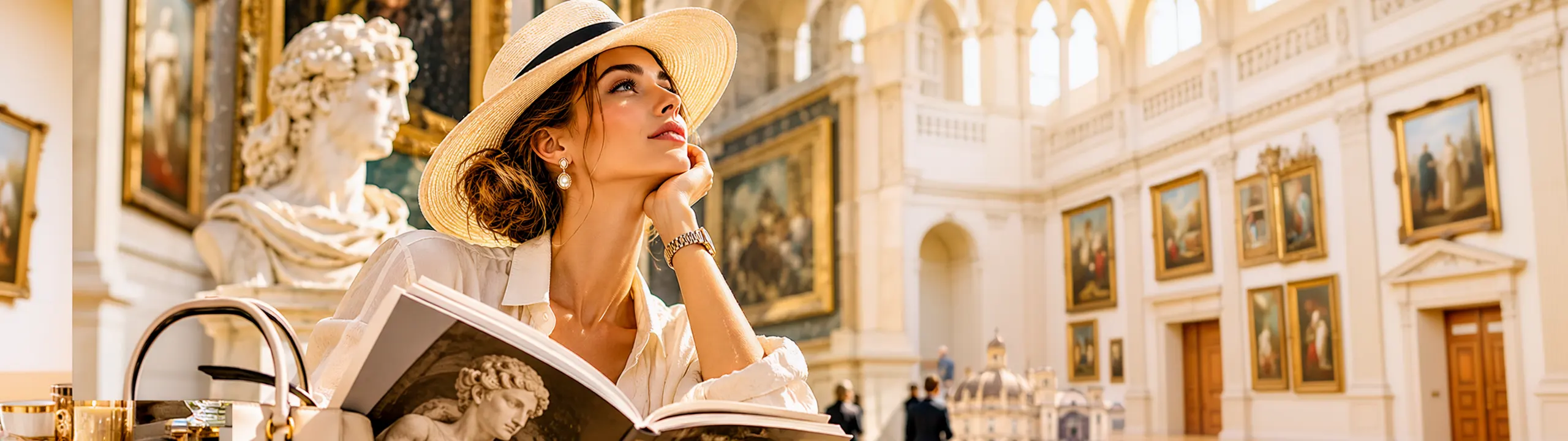
A life enriched by culture is a life that remains open to discovery. An exhibition, a performance, a film, a book, an architectural detail or a conversation with someone from a different background can alter the way the world is understood.
These experiences do not always need to be exclusive or expensive. Their value lies in the ideas they introduce and the feelings or questions they leave behind.
For a fashion and culture publication, this connection is essential. Fashion does not exist in isolation. It draws from art, history, music, craftsmanship, social change and the exchange of ideas between places and generations.
Curiosity also keeps personal taste alive. It invites us to look beyond familiar references, to encounter unfamiliar forms of beauty and to recognise that refinement can take many different shapes.
The well-lived life is not simply comfortable. It remains interested in the world.
Travel can offer distance from routine, but its greatest rewards often come from attention rather than distance. A destination becomes meaningful through its landscapes, food, architecture, traditions and the people who give it character.
The most memorable journey may include a remarkable hotel or a beautifully designed yacht, but it may also be a small restaurant, a local market, a conversation or an unexpected moment that could never have been planned.
A more considered approach to travel leaves room for the destination to speak. It respects local culture, values the knowledge of people who live there and recognises that meaningful hospitality is more than the performance of exclusivity.
For some, luxury travel means privacy and exceptional service. For others, it means immersion, discovery or the freedom to move at an unhurried pace. These preferences need not compete.
The journey is most rewarding when the experience feels connected to the traveller, rather than simply assembled around a familiar idea of status.
Objects can hold memories, but relationships create them. The pleasure of a shared meal, the reassurance of a familiar voice, the generosity of an invitation or the quiet understanding between friends can shape a life in ways that no purchase can reproduce.
This does not make material beauty unimportant. A thoughtfully chosen gift can express affection; a special setting can make a gathering memorable; a piece of jewellery may become part of a family story. The object becomes meaningful through the human connection it represents.
In a season increasingly associated with gifting and celebration, it is worth remembering that attention is often the most personal offering. Knowing what someone loves, making time to be together and giving without expectation can matter more than the scale of the gesture.
A richer life is rarely built alone. Its meaning is often found in what is shared.
A considered life is not a competition to own the fewest things, nor does it require rejecting pleasure. It asks for a clearer understanding of what deserves attention, money and space.
Some people find lasting pleasure in collecting art, watches or beautifully made objects. Others prefer to direct more of their resources towards travel, family, learning or time away from work. Many move between these priorities as life changes.
The important distinction is between a choice made freely and one made through pressure — the pressure to keep up, to display success or to acquire something simply because it is presented as desirable.
Conscious choices can also involve caring for what is already owned: repairing a garment, maintaining a watch, restoring furniture, passing on an object or buying pre-owned when it makes sense. These actions extend the life of things and deepen the relationship with them.
Enough is not a fixed quantity. It is a personal point of balance, and it can change over time.
If luxury is understood only through rarity, price and recognition, much of its contemporary meaning is missed. A life can be full of expensive things and still feel hurried, disconnected or short of space.
Equally, a considered life need not reject beautiful objects or exceptional experiences. It can welcome them while asking what they contribute, how they are made and whether they align with personal values.
For brands, the challenge is to create products and experiences that deserve a lasting place in people's lives. Quality, service, imagination, responsible care and a distinctive point of view all matter. The strongest proposition is not simply visibility; it is relevance that endures beyond the moment of purchase.
For consumers, the opportunity is to define luxury on their own terms — to choose what brings pleasure, meaning, beauty or ease, without feeling obliged to follow someone else's hierarchy of value.

The conversation around luxury often begins with what is desirable. It becomes more interesting when it turns towards what is meaningful.
A beautifully cut jacket, a fragrance that feels like a personal signature, a home filled with objects gathered over time, a journey that opens a new perspective or an evening shared with people who matter — each can enrich life in a different way.
None needs to be measured against another. Their value is found in the experience they create and the place they hold in an individual's world.
Perhaps the most contemporary expression of luxury is the ability to make thoughtful choices: to recognise quality without being ruled by status, to appreciate beauty without needing to possess everything, and to protect the time and relationships that make enjoyment possible.
Living well is not a finished achievement. It is an ongoing practice of attention — to what we choose, what we keep, what we share and what we allow ourselves to enjoy.
The richest life is not necessarily the one that owns the most. It is the one that makes room for what matters.

THE MOOD THIS WEEK — THE ART OF LIVING WELL

