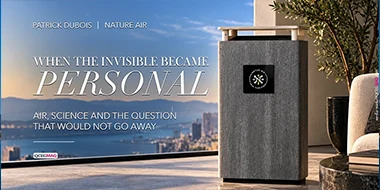







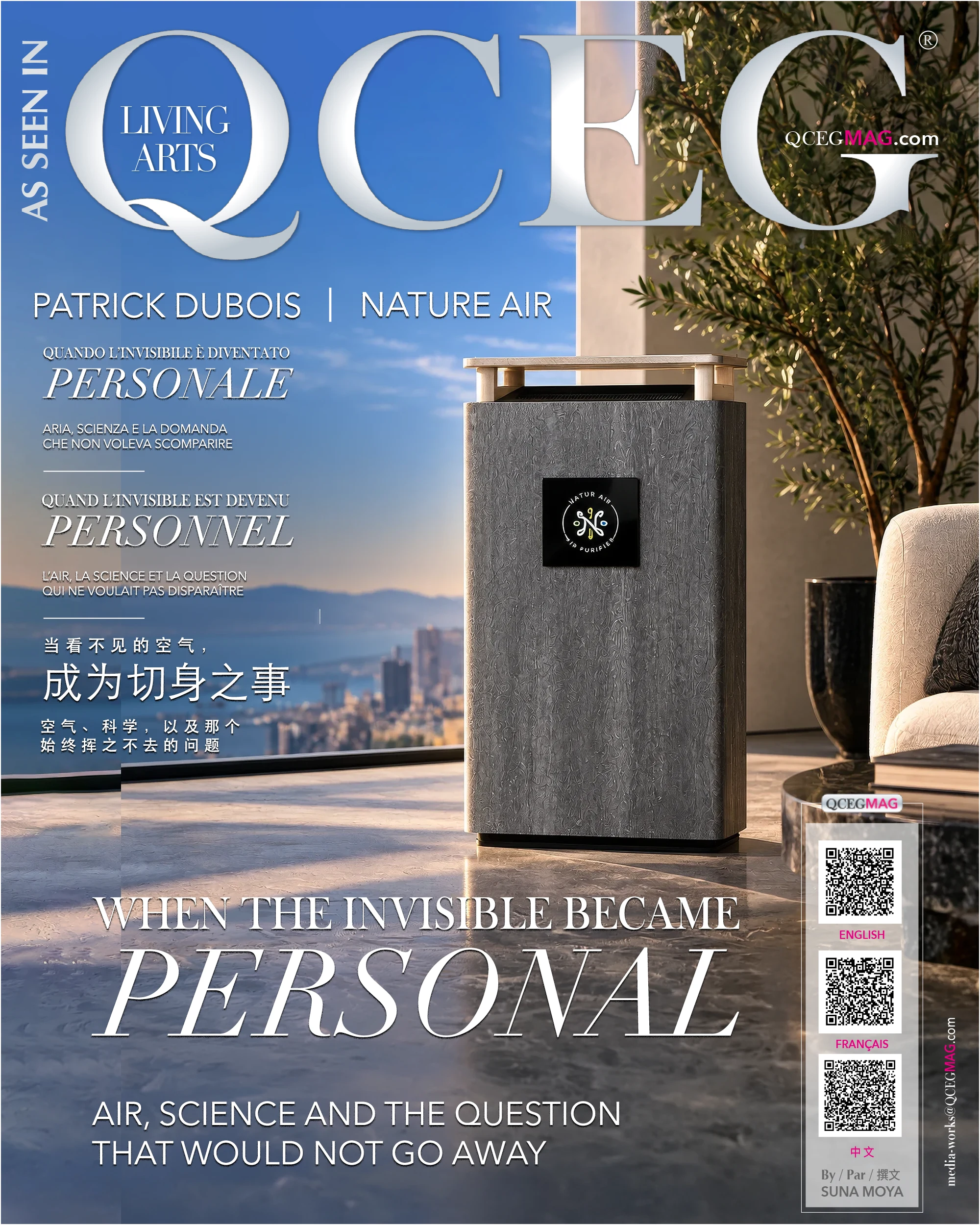
WHEN THE INVISIBLE BECAME PERSONAL AIR, SCIENCE AND THE QUESTION THAT WOULD NOT GO AWAY
PATRICK DUBOIS · NATUR AIR
Patrick Dubois, founder and president of Natur Air, did not begin with a theory about the future of air quality. He began with a personal experience that changed the way he looked at the world around him.
During the Covid-19 pandemic, Patrick became seriously ill and fell into a coma. When he woke, one question stayed with him: how can something we cannot see have such a profound impact on our lives? That question became personal before it became scientific.
Natur Air was already working on air pollution and developing technologies for cleaner air. But Patrick’s experience gave that work a different sense of urgency. He wanted to understand more deeply what moves through the air we breathe — from airborne particles and aerosols to fine and ultrafine particles — and how they behave, how they can be captured and, where scientifically possible, how they might be reduced.
He began speaking with virologists, professors, engineers and other specialists, determined to move beyond intuition and towards answers that could be measured, tested and reproduced.
"WHAT ARE WE ACTUALLY BREATHING, AND HOW MUCH DO
WE UNDERSTAND ABOUT WHAT MOVES THROUGH THE AIR?"
said Patrick Dubois
What began with a deeply personal experience became a broader mission: to better understand the air around us and find practical ways to improve it.
FROM INTUITION TO MEASUREMENT
That mission took an unexpected direction. Rather than beginning with the filter, Patrick and his team began with a more basic question: what happens to particles before they reach the filter? It led them to study phenomena such as Brownian motion, and to think differently about how pollutants move through air.
The idea was that effective purification is not only about the filter itself, but also about influencing how particles move, so that they reach the filtration system more effectively. It became an important principle for Natur Air — and it also created a problem. Having an idea is one thing. Proving that it works is something completely different.
When Patrick first presented the concept to scientists and engineers, the response was, by his own account, entirely reasonable: curiosity, but also scepticism. He was not an academic arriving with twenty years of published research. He was an entrepreneur saying that he believed there could be another way.
Their questions forced the team to distinguish between intuition, physics and measurable results. And once the results could be reproduced, the conversation changed. They were no longer discussing whether an idea sounded interesting. They were looking at data.
The turning point came when the system was tested in real environments. Real life is not a laboratory: people move around, doors open and close, outside air enters, and dozens of other variables intervene. When particle measurements in equipped spaces were compared with the surrounding environment, the difference was significant.
Testing in homes, offices and healthcare environments followed. Prototypes were built, airflow and filtration were tested, things were changed and the process began again. The question was always the same: does it work where people actually live and work?
MEASUREMENT, EVIDENCE AND THE REFUSAL TO DEPEND ON BELIEF
Air quality is invisible. You can see contaminated water; air pollution is far harder to perceive. We breathe thousands of times a day without necessarily knowing what is present in the air. That is why measurement sits at the centre of everything Natur Air does.
The systems monitor particles including PM10, PM2.5 and PM1, and use H14 HEPA filtration. But, as Patrick is careful to point out, the important question is not what a component can achieve in theory. It is what happens in an actual environment.
"WE WANT THE PERFORMANCE OF THE SYSTEM TO BE SOMETHING THAT CAN BE MEASURED RATHER THAN SOMETHING PEOPLE ARE SIMPLY ASKED TO BELIEVE."
A several-month monitoring study was conducted in a care home in Mandelieu-la-Napoule under normal operating conditions, comparing indoor air quality with outdoor conditions. The results were encouraging — but Patrick is equally clear about where the work currently stands. Independent testing, reproducible studies and evidence that can withstand scientific scrutiny remain the priority.
It is a position that runs through the entire conversation. Technology, he believes, should not depend on belief. If claims are going to be made about air quality, those claims have to be prepared to be tested.
The human case for that work is not abstract. Indoor air quality matters precisely because so much of our time is spent indoors: schools, healthcare facilities, care homes, workplaces, hotels and homes. Each has different needs, but they share one thing — people spend significant amounts of time inside them. In schools, the priority is a better environment for children and teachers. In healthcare and care homes, some of the people present may be particularly vulnerable.
Patrick is careful not to overstate. He would never claim that Natur Air can solve every air-related health problem, and he says so plainly: that would be irresponsible. The role he describes is narrower and more useful — to help make indoor air better measured, better controlled and better filtered. If that can be done reliably and at scale, the potential human impact is significant.
Looking further ahead, he believes air quality will increasingly become part of the infrastructure of a building. When we construct a hospital, a school or a hotel, we automatically think about electricity and water. He argues we should think just as carefully about the air people breathe — with buildings that monitor air quality continuously, detect changes and adjust treatment automatically, bringing sensors, filtration, data and intelligent control together as one system.

CONNECT WITH NATUR AIR
Website: www.natur-air.com
Perhaps what makes the Natur Air story compelling is its refusal to rely on atmosphere alone. There is a personal beginning, a clear question and an ambition that extends beyond a single product — but there is also a persistent insistence on measurement, on reproducibility and on being honest about what has and has not yet been proven.
“WE TESTED IT, WE REPRODUCED THE RESULTS, AND WE UNDERSTAND WHAT IT DOES.”
That, for Patrick, is the result he would ultimately most like to hear — and he says it would mean far more to him than any marketing claim. It is a modest sentence, and an ambitious one.
His own summary is simpler still. He wants what he creates to have a purpose beyond the company itself, and his greatest satisfaction would not be building a large business. It would be knowing that somewhere — a school, a hospital, a care home, a workplace or a home — people are breathing better because of something he helped to create.
With the project now moving from prototype to scale, QCEG MAG speaks exclusively with Patrick Dubois about air, science, evidence and the future of what we breathe.